Winning a Race on Pure Speed

Math is not my subject. It never has been. My mother was a math whiz, and both of my brothers are mechanical engineers. I took more after my father. While I always considered him a brilliant man, I don’t think he was very good in math either. Algebra almost put me on probation during my freshman year in college. Accounting almost prevented me from graduating. To this day, looking at a spreadsheet filled with numbers makes my eyes glaze over and my head spin.
I have great respect for those that can look at any situation and determine an outcome using mathematics. I can’t think on my feet that quickly. It boggles my mind.
In racing, it amazes me how strategists such as Chip Ganassi Racing’s Mike Hull or Barry Wanser can come up with a fuel strategy in a matter of moments on the fly. I couldn’t come up with what they do, if I had all day to sit and analyze it. They can see how a race is unfolding and figure out just the right course of action to take, regarding tire management and fuel strategy.
I was perusing through this week’s edition of Marshall Pruett’s Mailbag on Racer.com the other night, and I saw a question that sounded so simple on the front-end, but I think the answer may be very complicated – and much more complicated than Pruett made it seem in his answer.
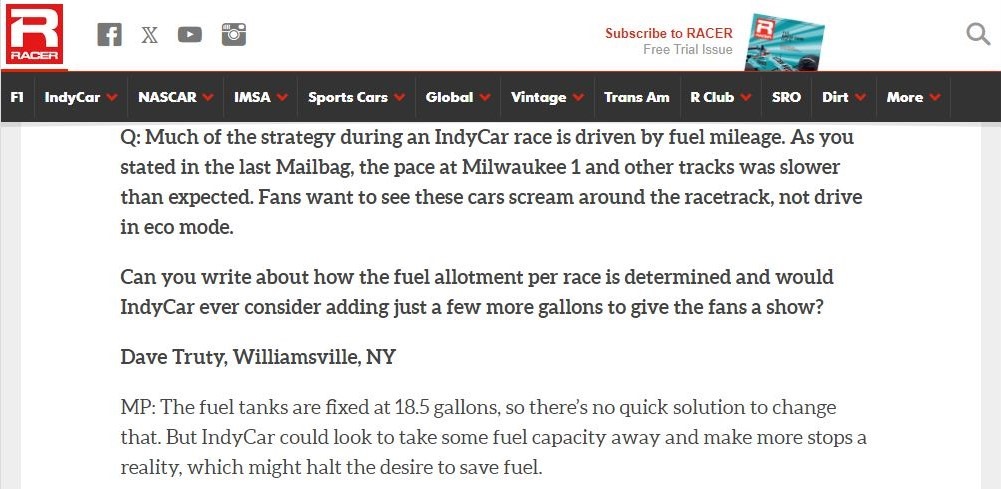
If we are looking to eliminate fuel mileage races, it seems it would be easier to make the race distance slightly longer. That’s much easier than reducing the size of the fuel cell, I would think.
Let’s take a random oval race as an example. If the race distance is 200 laps, and the general way of thinking says that a race should require four pit stops, some teams will try to do it in three. It might take a lot of laps under caution and some clever fuel saving tricks, but they just might be able to eliminate that fourth stop. Now, it’s boring for fans seeing a car get passed because they are in fuel-saving mode; but style points don’t count. Saving precious seconds on pit row could make the difference between first and fifteenth.
The two most glaring examples of this I can think of were Danica Patrick’s win at Motegi in 2008, and Alexander Rossi’s 2016 win in the Indianapolis 500. Neither were awe-inspiring drives with gutsy moves to pass cars. But they made one less stop than their competitors and they rumbled across the finish line first. IndyCar doesn’t award style points. This isn’t college football. Where you finish is your result. Rossi’s 2016 win counts just as much as Sam Hornish’s last-second pass of Marco Andretti ten years earlier.
But we race fans like to see speed, and we like those gutsy passes. In 1999 at Portland, Gil de Ferran was driving the Valvoline car for Derrick Walker. Everyone was trying to make it a fuel-mileage race. de Ferran was having none of that. While Juan Montoya, Dario Franchitti and all of the usual front-runners of that season were putt-putting around – de Ferran went full-rich with no regard to saving fuel. He built up a big enough lead going into his third pit-stop, that he still exited the pits in front of everyone else and won the race. That’s what fans want to see – winning a race on speed and driving ability, and not by hitting a fuel number lap after lap.
Portland was 98 laps that year, for a total of 192.766 miles. The general consensus was that it was better to avoid the added time in the pits and to conserve fuel. Fuel conservation means lack of passing. A lack of passing means less excitement for fans. You know what that eventually turns in to.
I guess you can reduce the size of the fuel cell. That would mean more pit stops. Would fans rather see more pit stops, or more passing on the track? It seems to me that if you slightly increase the number of laps, you eliminate the possibility of everyone trying to conserve fuel to minimize pit stops. Instead of having Portland run 98 laps, how about adding around 10 laps, or whatever number of laps that would make doing a two-stop race almost impossible. It is still short enough that no one would need to do for stops, but there would be no need for conserving fuel.
Some say that fuel strategies are part of what makes IndyCar racing exciting. I think that’s mostly because fuel-mileage races have become the norm in IndyCar racing. As I said earlier, I am amazed at how the race strategists can adjust on the fly and come up with a fuel strategy that works. But that’s not why I watch racing. I can get the thrill of watching a genius at work by watching a chess match or attending a spelling bee. Race fans want to see race cars race on the track, not in the pits. A good pit strategy should be one of many elements in a race – not the main element. I would like to see races put back in the hands of drivers that can go fast; not in the hands of strategists sitting comfortably on the pit box.
I remember watching that Portland race in 1999, when de Ferran went old-school and won a race strictly on speed and race craft. I remember how thrilling that was at the time. I also remember thinking how refreshing that was, and how I wished that racing could get back to that. More than 25 years later, I’m still wishing.
George Phillips
 Oilpressure
October 18, 2024 at 6:01 am
How about adding more horsepower? That would shake things up. My eyes glaze over the second a race has turned to fuel saving. Think of the difficulty of getting one’s self to a race. Travel, food, hotel, heat, weather only to hear George’s fav Townsend Bell burst out “Scott Dixon, the master is making fuel.”
October 18, 2024 at 7:49 am
eliminate math.
October 18, 2024 at 8:35 am
I would love to see the Indianapolis 500 raced (or any race) on just car and driver performance. When you see the final laps being done at about 80% of what they’re capable of, it’s not nearly as exciting. I remember one year I used my three math brain cells and looked at the difference between the average speed of the winner, and I think it was a car in about 15th place. It was only 1/2 MPH difference! What if that 15th place driver would have averaged 1/2 MPH faster?
I would love to see ANY race where everyone is turned lose to just go fast. And I think your idea of adding a few laps at the end would probably be the easiest way to eliminate the fuel save mode.
I do not know how many gallons the cars are allocated for each race, but I’m sure that could be adjusted to accommodate those extra laps!
October 18, 2024 at 8:52 am
Hear! hear! Fill em up, turn em loose, let the best driver win.🏎️🏁🏆
October 18, 2024 at 9:13 am
Any measure to rid us of fuel saving races.
I would pick some additional laps as you suggest.
Mind you, Dixon would immediately retire.
October 18, 2024 at 9:16 am
There is an enormous amount of racing done across the world where no fuel saving occurs, it’s called sprint racing. Indycar is not and never really has been sprint racing. The only way to make Indycar like sprint racing would be to have cars carry a full load of fuel for the entire race from the outset of a race. Seems unlikely, in no small part because of the weight it would add to the car when full. We think the cars are slow now saving fuel…
Now, there are ways to mitigate fuel saving, particularly George’s suggestion to add distance to races. Champcar used mandatory pit windows to reduce fuel saving, something that I recall being received by fans worse than fuel saving races generally have been. I’m not sure Pruett’s suggestion wouldn’t increase fuel saving, the more potential pit stops the more potential pit stops that could be eliminated using fuel strategy.
But there are pretty much no ways of eliminating fuel saving in a racing series that involves refueling. Adding distance to races can eventually cross into the territory of adding pit stops (and potential pit stops to eliminate via fuel saving), especially as the fuel economy of the cars may change from race-to-race and year-to-year. And even when drivers and teams aren’t trying to eliminate a pit stop over the course of a race, they are often saving fuel to reduce the amount of time they spend in their pit stalls and/or gambling on a caution being friendly to a long fuel stint.
October 18, 2024 at 9:40 am
Came to say the same about Sprint racing Vs. Championship racing. It is what it is.
Nice work, as always, Billy!
October 18, 2024 at 2:53 pm
I remember when live race telecasts reserved commercial breaks for pit stops so we wouldn’t miss the excitement of the racing. Now the telecasts run the commercials during the “racing” so we don’t miss seeing the pit stops.
I do remember several times when there were discussions about adjusting the length of races for force teams to make another stop, and I think that has been done once or twice.
I also remember when race distance was set by he sanctioning body without regard to TV windows. I also remember when we didn’t see any Indy car racing on TV unless it was an edited replay on Wide World of Sports.
October 19, 2024 at 3:29 pm
I remember too. I am not the biggest F1 fan anymore, but do love watching uninterrupted racing on race days. I wonder what F1 is paying Disney in order to be commercial free.
October 18, 2024 at 8:40 pm
I love Rossi’s Indy 500 win because he came back twice into top 10 after the fuel probe broke down twice on pit stops. It was a great win even if there was strategy