We’ve Seen It All Before

Now that the College Football season is officially over, and Ohio State has been crowned the champion, I am going to use a college athletics program as a comparison to racing – so bear with me.
Most know that I am a graduate and fan of the University of Tennessee. I am one of those shallow people that chose my college for the football team. While there has not been as much recent success as Ohio State or Alabama, Tennessee has a proud history full of rich traditions. Like the Indianapolis 500, Tennessee has some traditions that go back over a hundred years, and many that have been around for decades. Fans embrace those traditions and don’t like change. Remember my credo in life…Change is Bad!
In 2021, Tennessee hired a new Athletics Director named Danny White. Things have gone quite well for Tennessee athletics lately. In the last seven months. Tennessee has won a National Championship in baseball. The football team was 10-2, ranked No. 8 and made the first College Football Playoff, before getting crushed by an Ohio State team that pretty well crushed everyone in the playoffs.
The men’s basketball team spent five weeks as the No. 1 team in the nation. They are currently ranked No. 6 in the latest AP poll. The women’s basketball team has a new head coach, another Danny White hire along with the football coach, and they are currently ranked No. 15 in the nation.
With all of the Top-Four athletic programs having outstanding seasons; you would think fans would be happy. But White made an announcement back in August that has outraged fans, to the point that it overshadowed what I considered a very successful and enjoyable football season.
Pilot Oil is a Knoxville, TN based company. They own and operate the Pilot and Flying-J truck stops around the country. They have long been a supporter of the Vols athletic programs. Last summer, they signed a 20-year deal for as much as $21 Million annually for the rights to put signage around Neyland Stadium – the home of the Vols since 1921. Most importantly, this deal assures that there will be no name change to the stadium that carries the name of Tennessee’s most famous and revered coach – General Robert R. Neyland.
There was Pilot Signage on each end of the press-box, and the Pilot logo on each 25-yard-line. There are no distracting colors, just a while logo painted on the natural grass.
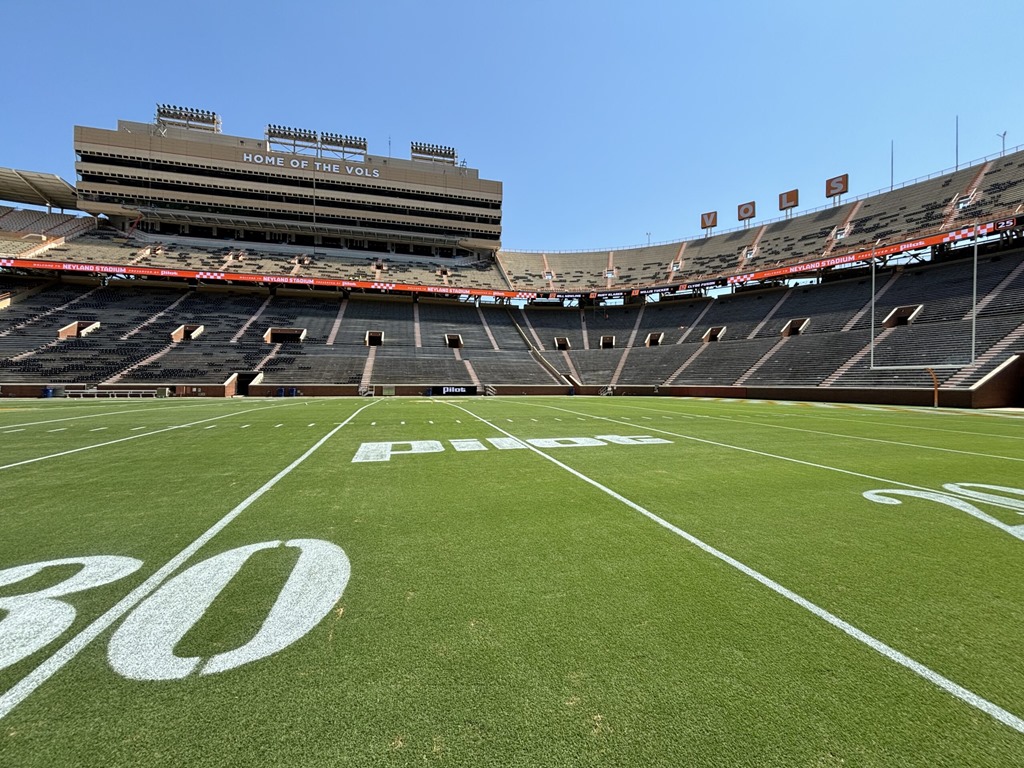
You would’ve thought Danny White painted the entire field Alabama crimson, the way people were up in arms. He was being crucified as someone who only cared about money. People forget where out teams were less than a decade ago. Now if he had changed the name to Pilot Field or Flying-J Stadium, I might be a little angry myself. But in this day and age of corporations being the driving force in sports, I didn’t really have a problem with a not-so-obvious white logo on the field.
It’s sort of the same thing with Doug Boles and the Indianapolis Motor Speedway. This is another facility that is cherished by so many that resist any change whatsoever. The Pagoda replaced the old Master Control Tower in 2000. I don’t really remember much gnashing of teeth when it popped up, but that was in the days before social media. I do recall some pushback when the apron was taken up before the 1993 race, and was replaced with separate pit entrance and exit lanes.
I just wonder what the outcry was when they paved the turns in the mid-30s, covering the bricks in the turns that had not already been patched with concrete. By that time, the Indianapolis 500 had been around for about a quarter-century. I’m sure many gasped when they heard the turns were being paved with asphalt over the bricks.
Getting back to present-day – I remember it was around 2006 (give or take a year) that Shell/Pennzoil signs first appeared on the walls of IMS. Many, including myself, were outraged. This was long before Boles took over as President. It was even before the Jeff Belskus days. I’m not sure if it was during the Joie Chitwood III reign or if it was strictly Tony George, but whoever was responsible for those first small signs on the walls in the turns – I was not pleased to see those pristine walls become billboards.
I don’t know if it was fan outcry, or if Shell decided there were better ways to spend advertising dollars – but the signs were gone the following year.
Of course, signage has reappeared and in greater number. Fuzzy’s Vodka paid enough money to get the Turn Two Suites painted a garish green, from the battleship gray that had adorned the suites since they first appeared in the seventies. I’m happy to say they are the normal gray again.
The PennGrade logo covered most of the grass inside Turn One for a few years. Fans didn’t like it, but they didn’t complain too much. To be honest, I’m not sure if the Gainbridge has been there for the last couple of years or not. The Yard of bricks has been surrounded by Tag Heuer logos for several years now. I’m so used to looking at them, I no longer think twice about it. Even the IMS Media Center is now officially referred to as the DEX Imaging Media Center.
The point is, racing fans have grown immune to Corporate America infiltrating every aspect of motor racing. Motorsports were the first to embrace the term corporate sponsorship back when Winston Cigarettes paid NASCAR to refer to their top series as Winston Cup. At that same time, Marlboro sponsored the 1971 USAC season, calling it the Marlboro Championship Trail, but everyone credits Winston for being the first and only.
In the mid-80s, football fans were shocked when college bowl games took on corporate sponsorship. The USF&G Sugar Bowl was probably the first major bowl game to take on a corporate sponsor and put the corporate name in the name of the event. Fans called the bowl games that took corporate money sell-outs and prostitutes. Just a few years later, it was unusual to find a bowl game without a corporate sponsor. The Rose Bowl was the last holdout, but even it became The Rose Bowl presented by AT&T.
This was nothing new to racing fans. This had become business as usual in the 70s. Even going back almost 100 years ago, you had the Bowe’s Seal Fast Special winning the 1931 Indianapolis 500.
Today, racing fans know that corporate dollars drive the sport. If Tag Heuer wants to put their logo on the side of The Pagoda, fans know that eventually goes into improving the facility or possibly improving the purse. I chuckled at the outrage of Vol fans, who were outraged by a colorless logo painted on the field. Do they not realize how that money is going to help the entire athletics budget? As racing fans, we’ve seen it all before.
George Phillips
 Oilpressure
January 22, 2025 at 9:14 am
Auto racing, particularly in the United States, has pretty much always been advertising-driven and certainly every living fan of the sport understands this. It was neat when Indy considered itself such hallowed ground that it did not display sponsorship signage. Any lament over the addition of sponsorship signage at IMS was probably more wistful than angry, sad to lose one of the small things that made Indy different from other races.
College athletics, though, came into existence in a very different place and with a very different relationship with money than auto racing. Perhaps naively, College sports fandom is traditionally tied to what athletic success supposedly says about the culture of a university… a situation that will become increasingly difficult to square with the emerging reality.